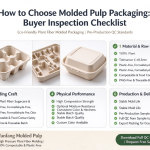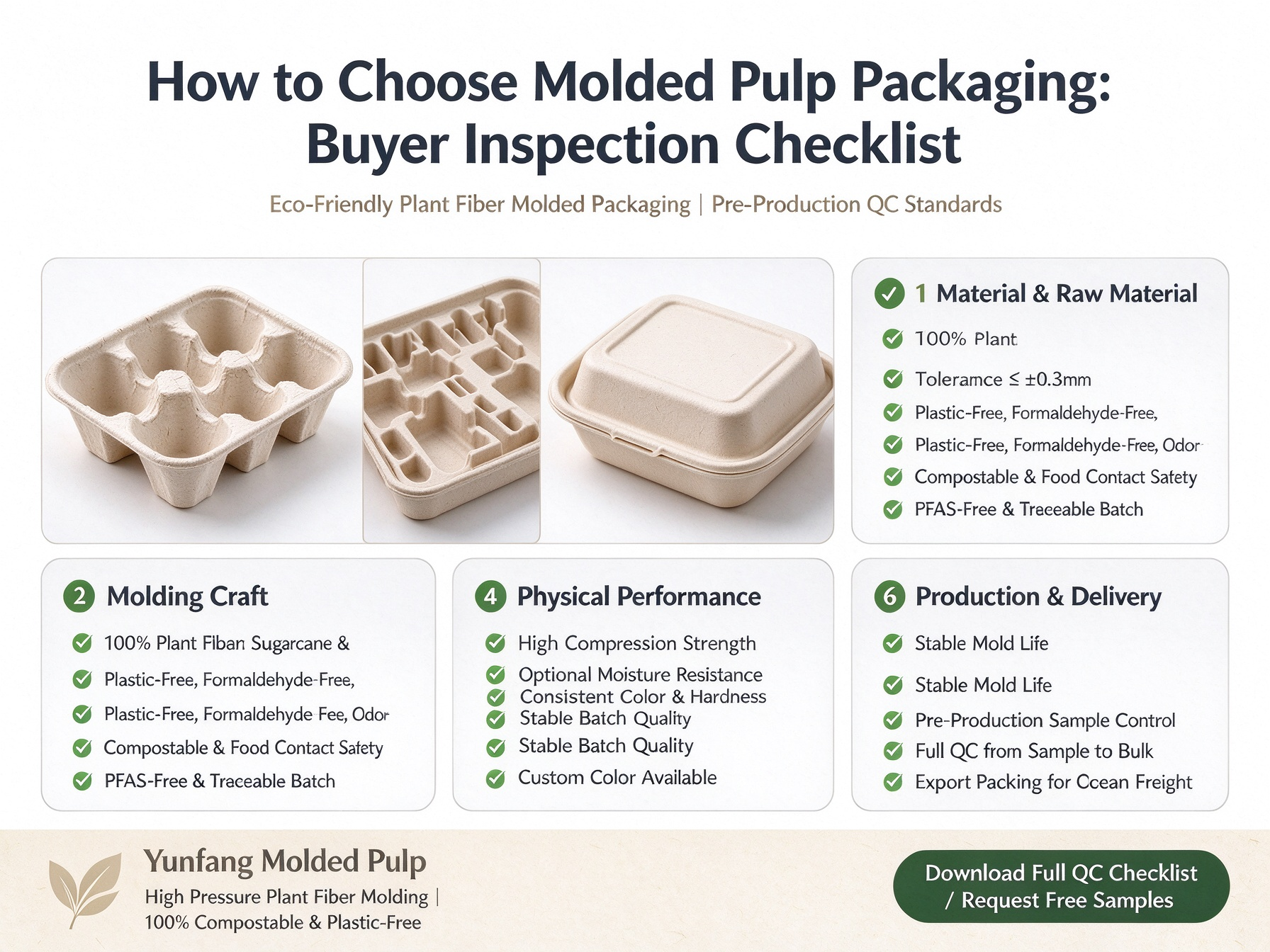
How to Choose Molded Pulp Packaging: A Buyer’s Checklist
Short answer: choosing molded pulp comes down to eight checks — what it has to protect, which process, wall thickness, tolerances, moisture limits, certifications, supplier capability, and true total cost. Skip any one of them and you will find the problem after tooling, when changes are expensive.
Why molded pulp, and where it is not the answer
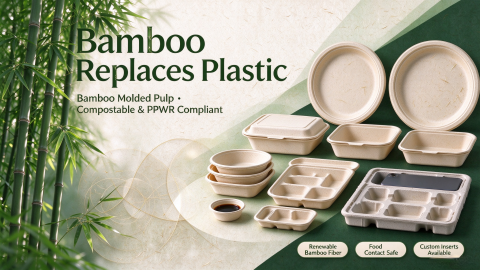
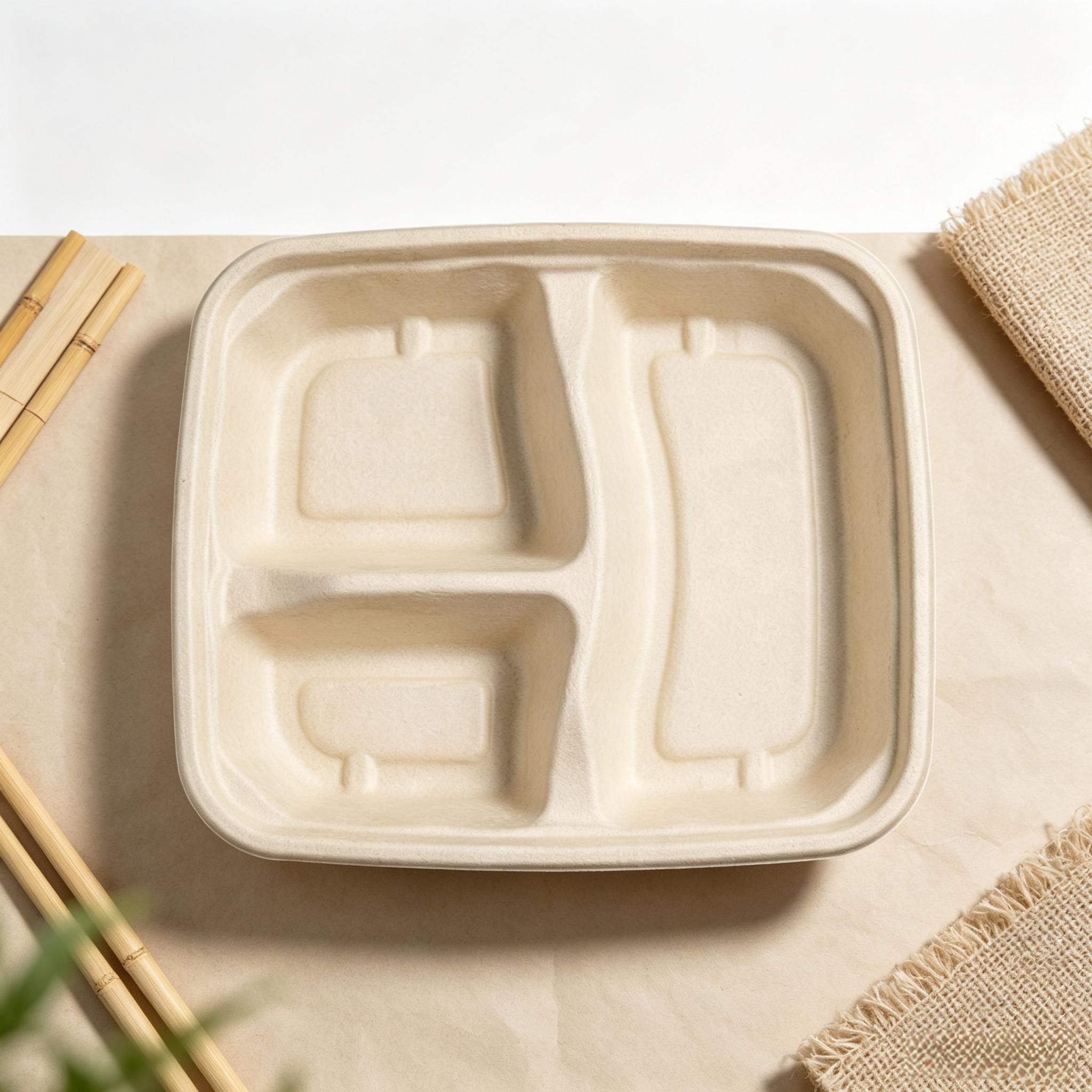
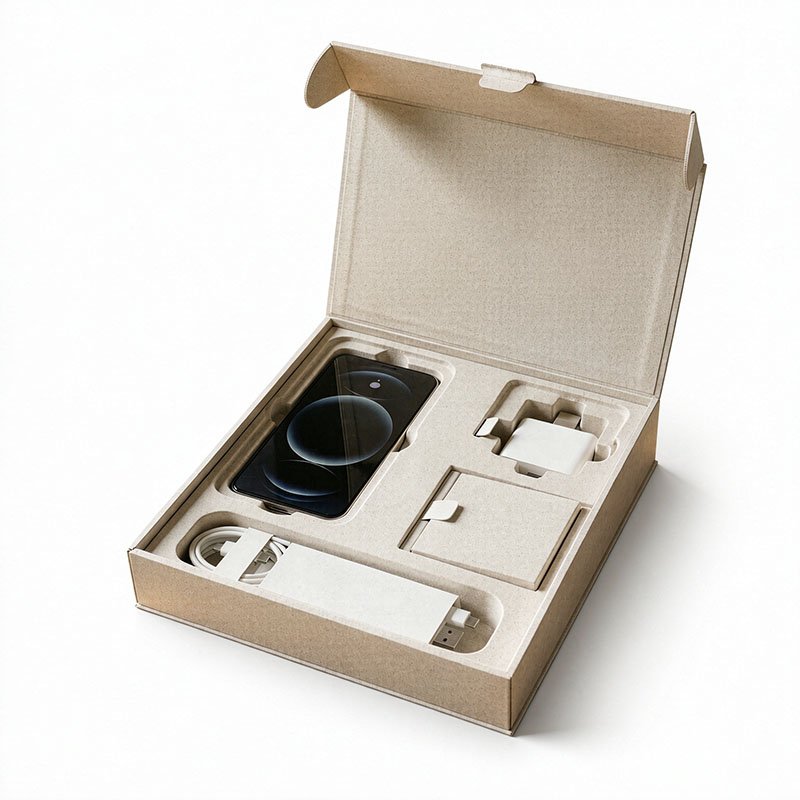
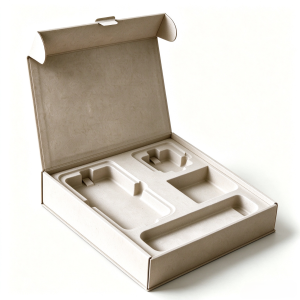
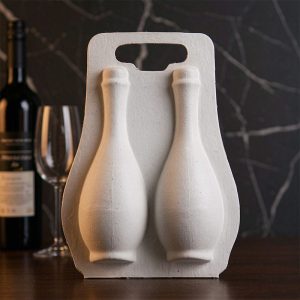
Molded pulp (also called molded fiber — same material, different regional habit) is formed from plant fiber: sugarcane bagasse, bamboo, recycled paper, wood pulp, reed. It replaces EPS foam, EPE foam, blister packs, vacuum-formed PET trays and corrugated inserts.
It wins on: end-of-life (compostable or recyclable in paper streams), no microplastics, nesting (empty trays stack, unlike foam), brand story, and increasingly compliance as plastic restrictions spread.
It is honest to say where it loses: it cannot hold injection-molding tolerances, it cannot form undercuts, it is opaque (no window display), it needs 3–5° draft on vertical walls, and uncoated fiber absorbs water. If your product must be visible through the pack, or the geometry has undercuts, molded pulp is the wrong tool.
The 8-point checklist
- Define the protection job first
Before material, write down what the part must survive:
- Product weight and the fragile element (screen, glass neck, ceramic edge)
- Drop height and the surface it lands on
- Stacking load in the outer carton, and stack height in the warehouse
- Vibration profile: courier parcel, palletized sea freight, or both
- Climate: cold chain, humid port, or dry warehouse
Practical test: ask the supplier to run drop tests at your real drop height on the actual product, not a substitute weight. A 1.2 m drop test is a common screening benchmark for protective inserts.
- Pick the process: wet press, dry press, or precision (thin-wall)
| Dry press (thick-wall) | Wet press / thermoformed | Precision (thin-wall) | |
| Surface | Rougher, fiber texture | Smooth, consistent | Smooth, tightest detail |
| Dimensional accuracy | Looser | Good | Best |
| Wall | Thick, higher grammage | Medium | Thin |
| Typical use | Industrial parts, hardware, auto, heavy loads | Food service (plates, bowls, clamshells), cosmetics | Consumer electronics, premium retail inserts |
| Direct food contact | Usually not suitable | Standard choice | Case by case |
| Cost | Lowest | Mid | Highest |
Rule of thumb: appearance-driven and food-contact jobs go wet press; load-carrying industrial jobs go dry press; tight-fit electronics go precision. Asking for “molded pulp” without naming the process gets you quoted the cheapest option and disappoints you later.Specify wall thickness and grammage — not just shape
3.Cushioning and cost both live in the wall. Thicker and denser means stronger and slower to compost, heavier and more expensive. Thinner saves money and material until the part starts cracking at the corners.
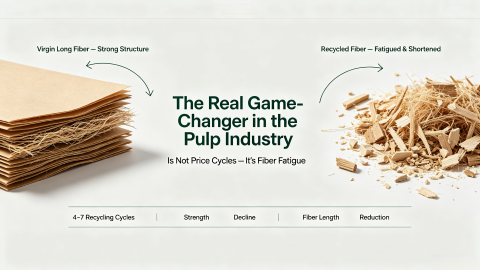
Ask for: nominal wall thickness, grammage (gsm), and a target compression or drop performance — then let the supplier propose. If a quote is dramatically cheaper than the others, check the long-fiber ratio and grammage; a part that is brittle in transit costs far more than the saving.
- Design to the process: draft, no undercuts, even wall
Three rules decide whether a part releases cleanly from the tool:
- Draft 3–5° on vertical walls
- No undercuts — the tool pulls straight apart
- Consistent wall thickness — thick and thin sections dry at different rates and warp
Also: generous radii at corners, avoid razor-thin ribs, and remember the part is opaque. If you can send the 3D file of the product being packaged, a capable manufacturer will come back with structural suggestions — that engineering input is worth more than a small price difference.
- Face the moisture question early
Uncoated fiber absorbs water. That is the honest starting point.
- Storage: keep below roughly 60% relative humidity, dry and ventilated. Damp warehouses grow mold on fiber — a real and common complaint.
- In transit: if the route includes cold chain, humid ports or long sea freight, plan an outer barrier (carton, liner, wrap) or consider a barrier-treated grade.
- Barrier options: PFAS chemistry is being restricted across multiple markets (California AB 1200, EU restrictions); ask for PFAS-free barrier systems (chitosan, plant wax, starch-based, AKD/ASA) and require third-party documentation, not a verbal claim.
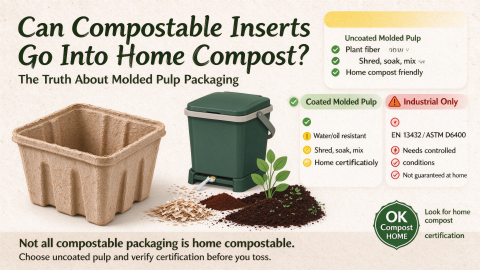
- Trade-off: coatings can improve water and grease resistance but may remove the product from compostability certification. Decide which matters more for your market before you specify.
- Ask for the right certificates — on the finished product
| Need | What to look for |
| Responsible fiber | FSC (or PEFC), with chain-of-custody documentation |
| Quality / environmental systems | ISO 9001, ISO 14001 |
| Compostability (North America) | BPI certification to ASTM D6400 |
| Compostability (Europe) | EN 13432, shown as OK Compost / Seedling / DIN-Geprüft |
| Food contact | FDA 21 CFR (US), LFGB / EU 1935/2004 (Europe) |
| PFAS | Total fluorine test report; written PFAS-free declaration |
The single most common mistake: accepting a certificate that covers the raw material instead of the finished product. Fiber can be certified and the finished tray still fail, because coatings, heat and additives change the result. Always ask for the certificate number, and check it against the certifying body’s registry. Note also that BPI and Seedling are industrial-composting marks — they are not home-composting certifications.
- Test the supplier, not just the sample
Samples are easy; repeatability is hard. Check:
- In-house tooling — can they cut and modify molds themselves, or is it outsourced? Outsourced tooling means longer changes and less control over accuracy.
- Tooling lead time — 4–8 weeks for new tooling is normal; factor it into your launch date before committing to a rollout.
- MOQ — commonly in the thousands of pieces per item. Ask whether small trial runs are possible and how the tooling cost is amortized across orders.
- Capacity — number of lines, peak-season headroom. Ask what happens if your volume doubles.
- QC — dimensional checks across multiple pieces from the same lot, plus metal detection where relevant.
- Export experience — documents, palletization, humidity management for sea freight.
- Compare total cost, not unit price
Molded pulp typically runs somewhat above EPS foam on unit price (commonly cited as roughly 10–20% higher), and the comparison flips once you count what foam costs you elsewhere:
- Avoided compliance risk — plastic restrictions, EPR fees, customs friction in restricted markets
- Nesting and cube — empty molded pulp nests; foam does not
- Damage rate — a better-fitting insert can cut returns more than the price delta
- Tooling amortization — spread over realistic annual volume, not the first order
- Freight — fiber is denser than foam per unit of protection; compare landed cost
Ask every supplier to quote unit price, tooling, MOQ, lead time and packing (pieces per carton / per pallet) in one table. If two quotes for “the same tray” differ by 2×, the difference is almost always fiber ratio, grammage, or process — not generosity.
Sample evaluation protocol (do this before you sign)
- Order samples from at least two suppliers, same spec.
- Weigh and measure 10 pieces from the same lot — check consistency, not just the best one.
- Fit test with your actual product, in your actual outer carton.
- Drop test at your real drop height, on the real corner.
- Stack test: loaded carton, at your warehouse stack height, for 24–72 hours.
- If there is moisture exposure: condition samples at elevated humidity for 48 hours, then repeat the drop test. Wet fiber behaves differently.
- Score pass/fail. A part that only works when staff pack carefully is not a production part.
Questions to email your supplier (copy-paste)
- Which process do you recommend for this part — dry press, wet press, or precision — and why?
- What nominal wall thickness and grammage are you quoting?
- Tooling cost, tooling lead time, and who owns the mold?
- MOQ per item, and is a smaller trial run possible?
- Do you hold certification on the finished product? Please send certificate numbers.
- Is the part PFAS-free? Please send the total fluorine test report.
- Can you run drop / compression testing to my conditions and share results?
- How many production lines, and what is your peak-season capacity?
- Dimensional tolerance you can hold, and how you verify it lot to lot.
- Packing data: pieces per carton, cartons per pallet.
Red flags: cannot produce certificate documents on request; vague about fiber source or grammage; no in-house tooling but promises complex geometry; coatings that cannot be confirmed PFAS-free; no dimensional control story.
FAQ
Is molded pulp cheaper than foam? Not on unit price — usually somewhat higher. On total cost it often wins once compliance risk, damage rate and freight cube are counted. Compare landed cost per shipped good unit, not per tray.
Can molded pulp replace my blister pack? Often yes for internal cushioning. It will not work if you need the product visible through transparent packaging, or if the geometry needs undercuts.
What is a realistic MOQ? Commonly in the thousands of pieces per item, varying with size and process. Tooling cost is the bigger barrier for small runs — ask how it is amortized.
How long does custom tooling take? Plan for roughly 4–8 weeks for new tooling, plus sampling and shipping. Build that into the launch date.
Is molded pulp waterproof? Not inherently, and this is the most important limitation to design around. Barrier-treated grades exist; storage below ~60% RH and a moisture-protected outer carton are standard practice.
Does molded pulp need a composting certification to be sold as sustainable? If you make a compostable claim, yes — and the claim must match the disposal route available in your market. An unverified claim is a legal and reputational risk, not a marketing asset.
Bottom line
Molded pulp is a good material making a bad decision only when the specification is vague. Name the process, the wall, the tolerance, the moisture condition and the certificate you need — and the quotes you get back will be comparable, and the part you receive will match the sample you approved.
Have a part to specify? Send the 3D file of the product, target volume and the conditions it must survive, and we will come back with a process recommendation, tooling estimate and unit pricing.